
Revelation 4 Explained: The Heavenly Throne Room and John’s Transition to Things to Come

Updated: Jan 16
In Revelation 1, Jesus instructed the Apostle John:
Revelation 1:19 - Write the things which thou hast seen, and the things which are, and the things which shall be hereafter.
Thus far, John has documented the things which he saw (Revelation 1) and the things which are - that is, the present spiritual condition of the churches at the time of writing (Revelation 2–3).
Revelation Chapter 4 and Chapter 5 mark a transition. They do not yet describe future events themselves, but rather the moment when John is taken in the Spirit and granted access to the heavenly realm from which the revelation of “things which shall be hereafter” would be disclosed.
From this point forward, the book shifts away from addressing present church conditions and towards revealing how John received insight into future purposes, judgments, and the reign of Christ. Due to the symbolic and visionary nature of Revelation, careful attention must be given to distinguishing between John’s historical experience of receiving the vision and the future events revealed through that vision.
The Transition into the Vision
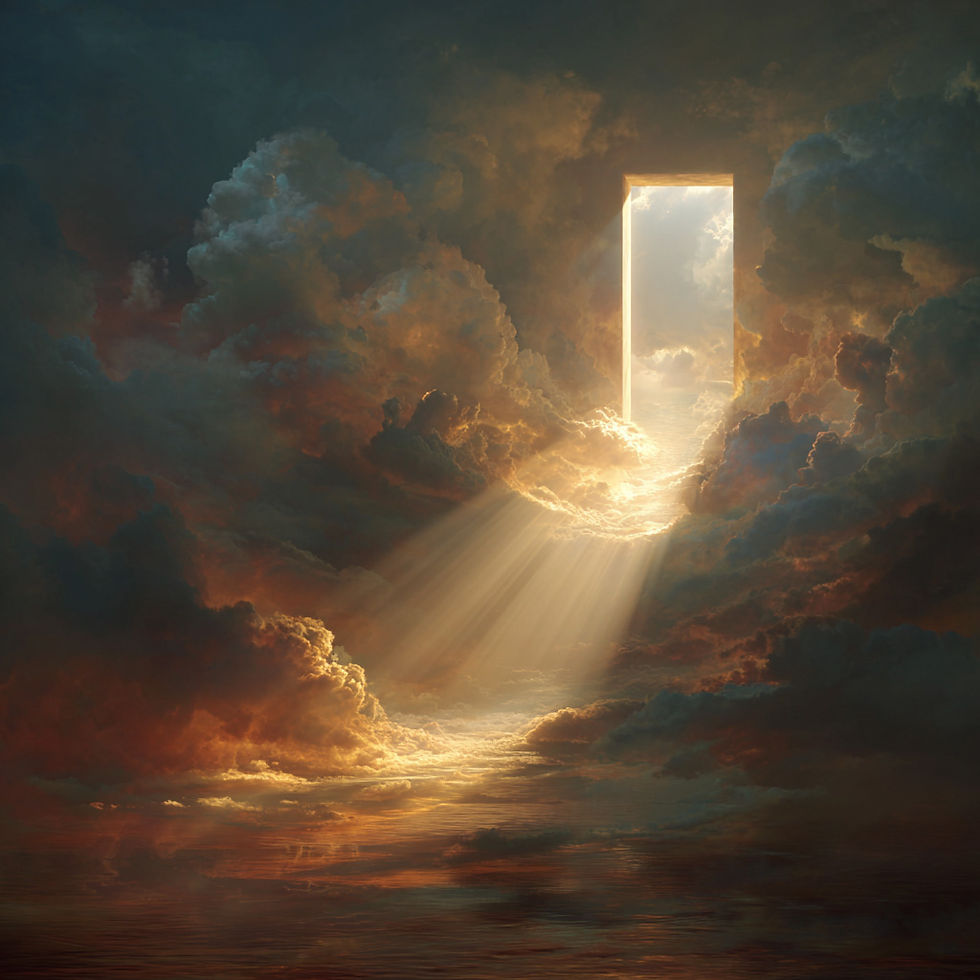
Revelation 4:1-2 - 1 After this I looked, and, behold, a door was opened in heaven: and the first voice which I heard was as it were of a trumpet talking with me; which said, Come up hither, and I will shew thee things which must be hereafter. 2 And immediately I was in the spirit: and, behold, a throne was set in heaven, and one sat on the throne.
These verses have caused much confusion within the modern Body of Christ, largely due to how they are taught by popular Bible scholars. They are frequently interpreted as a reference to the rapture - the moment when the saints rise to meet the Lord in the air. However, this interpretation is erroneous and results in an ill-prepared Church, unready for the sufferings Scripture clearly teaches will come upon the whole world - namely, the trumpet judgments (Revelation 8).
Revelation 4:1–2 is simply a record of John’s transition from documenting the things which are (Revelation 2–3) to the beginning of his documentation of the things which shall be hereafter.
John states that he saw a door opened in heaven. This was a vision given specifically to the apostle and does not align with any biblical description of the rapture. He then heard a voice saying, “Come up hither.” Many theologians interpret this invitation as symbolic of the rapture, but doing so violates a fundamental rule of biblical interpretation.
No Private Interpretation of Scripture
2 Peter 1:20 - Knowing this first, that no prophecy of the scripture is of any private interpretation.
We are not permitted to assign meaning to symbols based on personal perception. If Scripture presents a symbol, its meaning will be explained either within its immediate context or elsewhere in Scripture. God does not leave His Word open to imagination, for that would produce countless interpretations.
Isaiah confirms the method by which Scripture is understood:
Isaiah 28:10 - For precept must be upon precept, precept upon precept; line upon line, line upon line; here a little, and there a little.”
Nowhere in Scripture is John seeing an open door in heaven or hearing a voice saying “Come up hither” explained as a symbol of the rapture. Therefore, such an interpretation lacks biblical support.
The Trumpet Misunderstanding
Much emphasis is placed on the phrase:
“…the first voice which I heard was as it were of a trumpet talking with me…”
This is because Scripture teaches that the rapture occurs at the sound of a trumpet:
“At the last trump…” (1 Corinthians 15:52)
“With the trump of God…” (1 Thessalonians 4:16–17)
However, Revelation 4:1 does not say that a trumpet was blown. It says the voice sounded like a trumpet. A voice resembling a trumpet is not the same as the trumpet of God being sounded from heaven.
Why This Matters
These misinterpretations have led many believers to assume the rapture could happen at any moment, despite Scripture clearly outlining events that must occur first. As of January 14, 2026, major prophetic events that must still take place (in no particular order) include:
The building of the Third Temple in Jerusalem
The trumpet judgments (Revelation 8–14)
The revealing of the Antichrist
The ministry, death, and rapture of the two witnesses (Revelation 11), which occur before the rapture of the Church
Among these, the trumpet judgments provide the clearest timing markers. Scripture states the rapture occurs at the last trumpet (1 Corinthians 15:52). Since there are seven trumpet judgments, once the sixth trumpet occurs (Revelation 9), the seventh - and the rapture - will be near.
The Purpose of Revelation 4–5
Revelation 4:1 explains the transition from the documentation of the things which are to the things which shall be hereafter. John was invited into a heavenly proceeding - a special divine service - where he would be shown the future.
The events of Revelation 4–5 are transitional, occurring sometime around A.D. 95–96, when John received the Revelation on Patmos. They are not futuristic. They explain how John gained access to the heavenly realm, what he saw there, and how he received the knowledge of future events.
With this understanding, we now begin Revelation 4, which details a vision of the throne room of God and a moment of worship.
The Throne of God
Revelation 4:2–3 - 2 And immediately I was in the spirit: and, behold, a throne was set in heaven, and one sat on the throne. 3 And he that sat was to look upon like a jasper and a sardine stone: and there was a rainbow round about the throne, in sight like unto an emerald.
Here, John was caught up in an open vision into the third heaven and saw the throne room of God. The appearance of God was likened to the brilliance and beauty of precious stones - jasper (clear like crystal) and sardine (red like ruby). Surrounding the throne was a rainbow with the appearance of an emerald.
Jasper

Sardine

Emerald

It is important to note that this is not necessarily God’s fixed or permanent appearance. Throughout Scripture, God appears in various forms. Ezekiel 1:26–27 describes Him with the appearance of amber and fire, seated upon a blue throne. In Revelation 4, this is simply the form in which God chose to reveal Himself to John.
The Twenty-Four Elders
Revelation 4:4 - And round about the throne were four and twenty seats: and upon the seats I saw four and twenty elders sitting, clothed in white raiment; and they had on their heads crowns of gold.
Surrounding the throne were twenty-four elders, seated on thrones and clothed in white raiment, with crowns of gold.
Scripture does not explicitly identify these elders. Therefore, it is not appropriate to speculate. What is clear is that they are called elders, indicating they are men, not angelic beings.
Hebrews 12:22–24 describes the heavenly assembly and lists:
Angels
The Church
God
The spirits of just men made perfect
Jesus
Given that members of the Church do not receive crowns and white raiment until the rapture (2 Timothy 4:8; Revelation 3:5), these elders cannot be members of the New Testament Church. Rather, they are spirits of just men made perfect - faithful individuals such as Abraham, Job, and the prophets, who lived and died before Christ.
At Christ’s resurrection, He descended into the lower parts of the earth and brought these saints into perfection (Ephesians 4:9–10; Matthew 27:52–53). Hebrews later calls them a great cloud of witnesses - now dwelling in heaven as testimony that even death cannot thwart the promises of God.
Thus, the twenty-four elders are honored representatives from this company, seated in God’s presence. Their names are not revealed, and Scripture gives no warrant for speculation.
Worship in the Throne Room
Revelation 4:5 - And out of the throne proceeded lightnings and thunderings and voices: and there were seven lamps of fire burning before the throne, which are the seven Spirits of God.
John carefully explains the symbolism: the seven lamps are the seven Spirits of God, previously identified in Isaiah 11:2–3. God consistently ensures that His symbols are interpretable through Scripture.
Revelation 4:6 - And before the throne there was a sea of glass like unto crystal: and in the midst of the throne, and round about the throne, were four beasts full of eyes before and behind.
A sea of glass functions like a mirror - reflecting whatever is above it. The significance of the sea of glass will become clearer later in Revelation.
The Four Living Creatures
Revelation 4:6-8 - 6 And before the throne there was a sea of glass like unto crystal: and in the midst of the throne, and round about the throne, were four beasts full of eyes before and behind. 7 And the first beast was like a lion, and the second beast like a calf, and the third beast had a face as a man, and the fourth beast was like a flying eagle. 8 And the four beasts had each of them six wings about him; and they were full of eyes within: and they rest not day and night, saying, Holy, holy, holy, Lord God Almighty, which was, and is, and is to come.
These four living creatures - lion, calf, man, and eagle, are also described in Ezekiel 1. They are spiritual beings that attend the Lord continually, moving swiftly and offering unceasing worship.
These beings, along with other angels, will later serve as primary communicators with John as he receives revelation of future events (Revelation 1:1).
The Chapter Concludes in Worship
Revelation 4:10-11 - 10 The four and twenty elders fall down before him that sat on the throne, and worship him that liveth for ever and ever, and cast their crowns before the throne, saying, 11 Thou art worthy, O Lord, to receive glory and honour and power: for thou hast created all things, and for thy pleasure they are and were created.
Revelation 4 ends with a great worship service. The elders rise from their thrones and cast their crowns before God, acknowledging that all honor and authority originate from Him alone.
Praise and worship are rendered to the Lord God Almighty, the Father of our Lord Jesus Christ, who lives and reigns forever.
Amen.

Blog Title: Revelation 4 Explained: The Heavenly Throne Room and John’s Transition to Things to Come
Keyword: Revelation 4 explained
Previous Post in the Series: Revelation 3 Explained: Christ’s Judgment of Sardis, Philadelphia, and Laodicea
Next Post in the Series: Revelation 5 Explained: The Sealed Book, the Worthy Lamb, and the Revelation of Things to Come


Comments